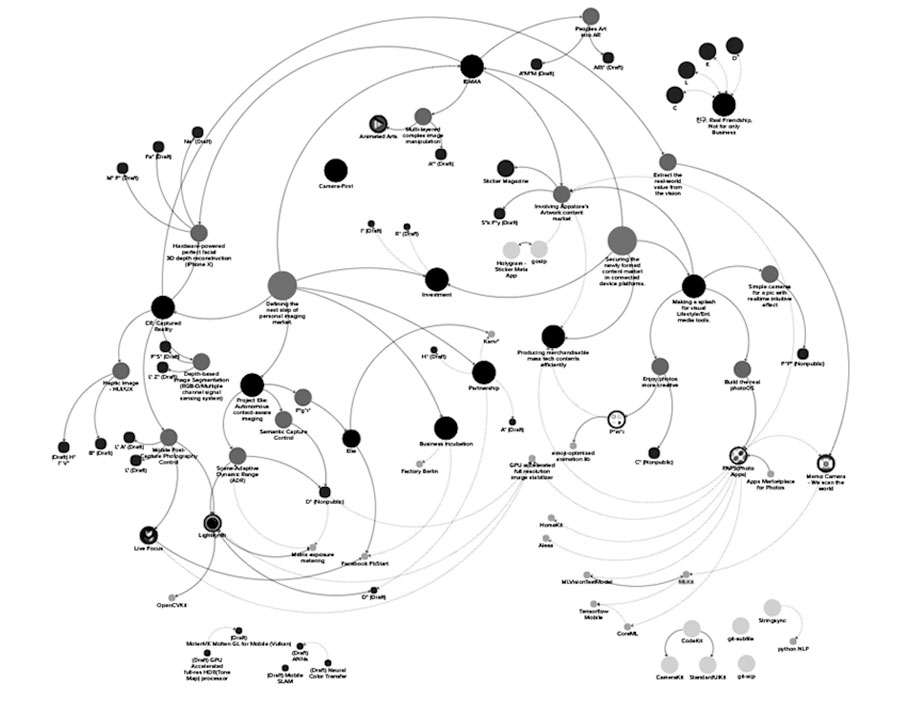
Quasi-Stellar Network
We devised the QSN, a topological abstraction model for materializing every concept, simplifying idea creation, and managing all kinds of visible or invisible resources. We are merely calling it “Quasar Net.”
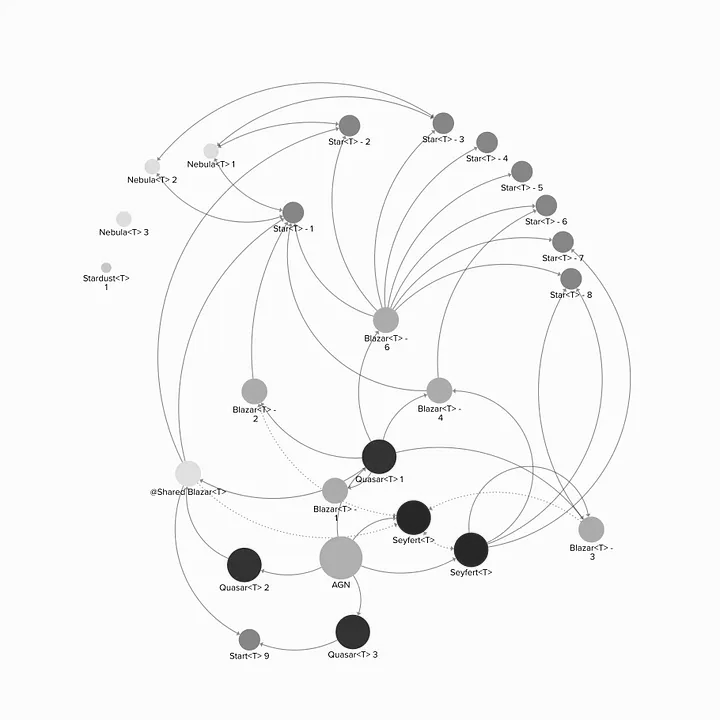
A Pseudo Network of QSN
Therefore, it can also be used as a well-designed model for all kinds of practical work as well as the consistent stream of consciousness. This includes ideology, mission, managing and expanding values, storytelling, businesses, organizations, goals, concepts, knowledge, resources, and technologies as an impetus, projects, results, and finally mutual complementary relationships among them all.
Elements
AGN — Active Galactic Nucleus
The mission.
Quasar
Core concept generator. Technology and research approach.
Seyfert
Core strategy generator. Business and product approach. Generates references and products.
Blazar
A materialized entity by Quasar or Seyfert. A concept including all kinds of realizable ideas and their materials. A small-sized Quasar.
Star
A realized entity from Blazar, Quasar, or Seyfert. Usually a project.
Nebula
All kinds of continuously maintained work-products or tools produced when a Star is newly created or ends.
Stardust
All commonly used or shared atomic assets, materials, opportunities, or features, including external knowledge from research. Can be referenced by all elements excluding AGN.
XMM-Newton
A reference. Technology or business observer of Seyfert.
Chandra
All things that we do not yet understand.
Connections
- Single direction + Solid line: The direction of the arrow indicates a child node, representing the actual relationship for creation.
- Mutual direction + Solid line: The direction indicates the same level, representing the actual relationship for creation.
- Single direction + Dashed line: A one-way reference.
- Mutual direction + Dashed line: Mutual reference.
Rules
- The size of each node indicates the degree of its abstraction.
- Quasar must be a child node of AGN.
- Quasar cannot be directly connected to another Quasar.
- Seyfert can be a child node of AGN.
- Seyfert can independently exist.
- Seyfert can be a parent node of all nodes excluding Quasar, Nebula, and its own parent.
- Seyfert can be a reference node of all nodes excluding Quasar, Nebula, and its own parent.
- Seyfert can be directly connected to another Seyfert.
- Blazar must be a child node of Quasar and Seyfert.
- Blazar can be a reference node of Seyfert.
- Blazar can be a reference node of Nebula if Nebula is commonly used by its Stars.
- Blazar can be shared as a child node with another of its own parents.
- Star must be a child node of Quasar, Blazar, or Seyfert.
- Star can be a reference node of Quasar, Blazar, or Seyfert.
- Star must be a node at the same level as Nebula.
- Nebula can be a node of Star at the same level if exclusively dependent.
- Nebula can be a child node of another Nebula.
- Nebula cannot be at the same level as another Nebula.
- Nebula can be disconnected from all nodes if commonly used.
- Nebula can be shared with another Nebula or Star.
- Stardust can be a reference node for all nodes excluding AGN or be disconnected from all.
- Stardust can be a child node of Star.
Notandum
The abstraction degree of the node:
- The most abstract node, AGN, has the largest size.
- The most specific and practical technical element is the smallest circle.
- These sizes do not indicate importance.
For example, the core difference between the Quasar-Blazar-Star (QBS) chain and the Nebula-Stardust (NS) chain is not “scale” or “importance,” but rather “deepening for technology” or “realistic property.”
A Real Example for Us